|
Being prepared for an exam means more than just knowing electrical concepts, the Code, and the calculations.
Have you felt prepared for an exam, then choke when actually taking it? Many good and knowledgeable electricians
couldn't pass their exam because they did not know how to take an exam.
Taking exams is a learned process that takes practice and involves strategies.
The following suggestions are designed to help you learn these methods.
•
Proper Supplies.
First of all, make sure you have
everything needed several days before the exam. The night before the exam is not
the time to be out buying pencils, calculators, and batteries. The night before
the exam, you should have a checklist (prepared in advance) of everything you
could possibly need. The following is a sample checklist to get you started.
Six sharpened #2H pencils or two mechanical pens with extra #2H leads. The
kind with the larger leads are faster and better for filling in the answer
circles.
Two calculators, just in case. Most examining boards require quiet, paperless calculators.
Solar calculators are great, but there may not be enough light to operate them.
Spare batteries. Two sets of extra batteries should be taken. It's very unlikely
you'll need them but.
Extra glasses if you use them.
Have all of your reference materials, even the ones not on the list.
Let the proctors tell you which ones are not permitted.
A thermos of something you like to drink. Coffee is excellent.
Some fruit, nuts, candy, aspirin, analgesic, etc.
•
The Night Before.
Take time the night before to:
-
Lay out the clothes you are going to wear and make sure they are comfortable, and pressed.
-
Make sure that you have directions, and your admittance slip for the test-taking location. The last thing you need is to get lost on the way to your exam. Know where the exam is going to take place and how long it takes to get there. Arrive at least 30 minutes early. It's a good idea to pack a lunch rather than going out. It can give you a little time to review the material for the afternoon portion of the exam, and it reduces the chance of coming back late.
-
Make sure you eat a healthy dinner. This includes vegetables, lean meat, and rice or pasta. Don’t eat too late or you won’t be able to fall asleep.
-
In the morning, have a light breakfast. If your test is in the evening, make sure to have a light snack before heading off to your test.
•
Relax.
This is easier said than done, but it is one of the most important factors in passing your exam.
Stress and tension cause us to choke or forget. Everyone has had experiences where they get tense and couldn't
think straight. The first step is becoming aware of the tension and the second step is to make a deliberate effort
to relax. Make sure you're comfortable; remove clothes if you are hot, or put on a jacket if you are cold.
There are many ways to relax and you have to find a method that works for you.
Two of the easiest methods that work very well for many people follow:
Breathing Technique: This consists of two or three slow deep breaths every few minutes.
Be careful not to confuse this with hyperventilation, which is abnormally fast breathing.
Single-Muscle Relaxation: When we are tense or stressful, many of us do things like clench our jaw,
squint our eyes,
or tense our shoulders without even being aware of it. If you find a muscle group that does this, deliberately
relax that one group. The rest of the muscles will automatically relax also.
Try to repeat this every few minutes, and it will help you stay more relaxed during the exam.
•
Skip The Difficult Questions.
To answer a question correctly, you must first understand the question.
One word in a question can totally change the meaning of it. Carefully read every word of every question.
Underlining key words in the question will help you focus. Contrary to popular belief, you do not have to
answer one question before going on to the next one. The irony is that the question you get stuck on is one
that you will probably get wrong anyway no matter how much time you spend on it.
This will result in not having enough time to answer the easy questions.
You will get all stressed-out and a chain reaction is started.
More people fail their exams this way than for any other reason.
The following strategy should be used to avoid getting into this situation.
First Pass:
Answer the questions you know. Give yourself about 30 seconds for each question. If you can't find the answer in
your reference book within the 30 seconds, go on to the next question. Chances are that you'll come across the answers
while looking up another question. The total time for the first pass should be 25 percent of the exam time.
Second Pass:
This pass is done the same as the first pass except that you allow a little more time for each question, about 60 seconds.
If you still can't find the answer, go on to the next one. Don't get stuck. Total time for the second pass should be
about 30 percent of the exam time.
Third Pass:
See how much time is left and subtract 30 minutes. Spend the remaining time equally on each question.
If you still haven't answered the question, it's time to make an educated guess. Never leave a question unanswered.
Fourth Pass:
Use the last 30 minutes of the exam to transfer your answers from the exam booklet to the answer key.
Read each question and verify that you selected the correct answer on the test book. Transfer the answers carefully
to the answer key. With the remaining time, see if you can find the answer to those questions you guessed at.
•
Remember, in the first pass answer only the easy questions. In the second pass, spend a little more time
per question, but don't get stuck. In the third pass, use the remainder of the time minus 30 minutes. In the fourth pass,
check your work and transfer the answers to the answer key.
•
Changing Answers.
When re-reading the question and checking the answers during the fourth pass, resist the urge to change an answer.
In most cases, your first choice is best and if you aren't sure, stick with the first choice. Only change answers if you are sure you made a mistake.
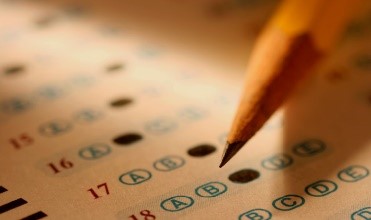
Multiple choice exams are graded electronically so be sure to thoroughly erase any answer that you changed. Also erase any stray pencil marks from the answer sheet.
•
Check Your Work.
The first thing to check (and you
should be watching out for this during the whole exam) is to make sure you mark the answer in the correct spot. People have failed the exam by 1/2 of a point.
When they reviewed their exam, they found they correctly answered several questions on the test booklet, but marked the wrong spot on the exam answer sheet.
They knew the answer was "(b) False", but marked in "(d)" in error.
Another thing to be very careful of, is marking the answer for, let's say question 7, in the spot reserved for question 8.
•
Guessing.
When time is running out
and you still have questions remaining, GUESS! Never leave a question
unanswered. You can improve your chances of getting a question correct
by the process of elimination. When one of the choices is None of
these, or None of the above, it is usually not the correct answer.
This improves your chances from one-out-four (25 percent), to one-out-three
(33 percent). Guess "All of these" or "All of the Above",
and don't select the high or low number. How do you pick one of the
remaining answers? Some people toss a coin, others will count up how
many of the answers were A's, B's, C's, and D's and use the one with
the most as the basis for their guess.
Know where the exam is going to take place and how long it takes to get there. Arrive at least 30 minutes early.
It'is a good idea to pack a lunch rather than going out. It can give you a little time to review the material for
the afternoon portion of the exam, and it reduces the chance of coming back late.
•
Rounding.
You should always round your answers to the same number of places as the exam's answers. Numbers below .5
are rounded down, while numbers .5 and above are rounded up.
Example:
If an exam has multiple choice of: "(a) 2.2, (b) 2.1, (c) 2.3, and (d) none of these",
and your calculation comes out to 2.16, do not choose the answer "(d) none of these".
The correct answer is (b) 2.2, because the responses are rounded off to the tenth.
Example:
It could be rounded to tens, such as: "(a) 50, (b) 60, (c) 70, and (d) none of these".
For this group, an answer such as 67 would be (c) 70, while an answer of 63 would be (b) 60.
The general rule is to check the question's choice of answers then round off your answer to match it.
SUMMARY
•
Make sure everything is ready and packed the night before the exam.
•
Don't try to cram the night before the exam, if you don't know it by then.
•
Have a good breakfast.
•
Get the thermos and energy snacks ready.
•
Take all your reference books.
•
Let the proctors tell you what you can't use.
•
Know where the exam is to be held and be there early.
•
Bring ID and your confirmation papers from the license board if there are any.
•
Review your NEC while you wait for your exam to begin.
•
Try to stay relaxed.
•
Determine the time per question for each pass and don't forget to save 30
minutes for transferring your answers to the answer key.
•
Don't get stuck on any one question.
•
Read each question carefully.
•
Be sure you are marking the answer in the correct spot on the answer sheet.
•
Don't get flustered or extremely tense.
|