Article 215 - Feeder
Q. Explain the requirement for voltage
drop in the NEC as it applies to feeders and branch circuits.
Section 215-2(b) FPN No. 2. Conductors
for feeders as defined in Article 100, sized to prevent a voltage drop exceeding 3 percent
at the farthest outlet of power, heating, and lighting loads, or combinations of such
loads, and where the maximum total voltage drop on both feeders and branch circuits to
the farthest outlet does not exceed 5 percent, will provide reasonable efficiency of operation.
- The NEC does not contain any requirements
that ungrounded or grounded conductors be sized to accommodate voltage drop.
- Voltage drop affects the efficiency
of the equipment, but is not a safety issue.
- The NEC recommends [FPN's to 210-19(a),
215-2(b), and 310-15] a maximum of 3% voltage drop for branch circuits, a maximum
of 3% voltage drop for feeders, but a maximum of 5% voltage drop overall for branch
circuits and feeders combined.
Q. If a No. 3 THW rated 100 amperes
(Table 310-16) is used for a 120/240 volt single-phase feeder, what would be the voltage
at the panelboard be if the panelboard is 75 feet from the service and the panel load
is 80 amperes? The resistance of the No. 3 conductor is .245 ohms per 1,000 feet (Chapter
9 Table 9).
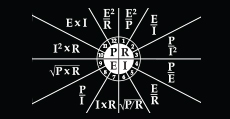
Voltage drop is equal to I x R, I =
80 amperes, R = [(.245 ohms/1,000 feet) x 150 feet], E = 80 x .03675 ohms, E = 2.94 volts.
This makes the voltage at the panel 240 volts less 2.94 volts = 237.06 volts.

Article 220 - Branch/Feeders
and Service Calculations
Q. Unless other voltages are specified,
when computing branch circuit, feeder, and service calculations, a nominal system voltage
of _____shall be used.
Section 220-2. When performing
branch circuit, feeder, and service calculations a nominal system voltage of 120, 120/240,
208Y/120, 240, 480Y/277, or 480, shall be used unless the voltage is different, such as
115/230. In addition, 1996 NEC now permits 600Y/347 volt systems.
Q. The branch circuit computed load
shall not be less than _____% of the continuous load, plus _____% of the noncontinuous
load.
Sections 220-3(a), 220-10(b), and
384-16(c). The NEC requires the branch circuit computed load for conductor sizing
to be sized at 125% of the continuous load, plus the noncontinuous load (100%).
Q. What is the demand load for nine
convenience receptacles added to a dwelling unit?
Zero VA. Table 220-3(b), general use
receptacles not greater than 20 amperes are included in the 3 VA per foot of the general
lighting load.
Q. For lighting other than general
illumination, receptacle outlets shall be rated as _____ VA minimum.
180 VA, Section 220-3(c)(6).
Q. What is the maximum number of
duplex receptacles on a two-wire 20 ampere circuit?
Section 220-3(c)(6). The NEC
does not have a specific rule that says 10 receptacles on a 15 ampere circuit or 13 receptacles
on a 20 ampere circuit. For 15 ampere circuits, the calculation is as follows: 120 volts
x 15 amperes = 1800 VA/180 VA = 10 receptacles, and for 20 ampere circuits, 120 volts
x 20 amperes = 2400 VA/180 VA = 13 receptacles.
- Many people think that when calculating
the number of receptacles the load should be reduced by 80%, but this is not the case!
Yes, the NEC limits the load on receptacle circuits to 80% for portable appliances
[210-23(a)] and, yes, the maximum continuous load on a branch circuit shall not exceed
80% of the circuit rating (protection device) [220-3(a) and 384-16(c)], but these
rules don't apply to the number of receptacles per circuit. I wish the NEC were more
specific, but it's not.

Q. Explain the rules that apply to
dwelling unit branch circuits.
There are many Articles that apply to
branch circuits, such as 210; Overcurrent Protection, 240; Wiring Methods, 300; Conductors,
310; Appliances, 422; Electric Space Heating Equipment, 424; Motors, 430; and Air-Conditioning,
440. A summary of Article 220 branch circuit rules is as follows:
- Voltage for calculation shall be
120, 120/240, 208Y/120, 240, 480Y/277, and 480 [220-2(a)].
- When a combination of continuous
and noncontinuous loads are present, the branch circuit conductor is sized based on
125% of the continuous load and 100% of the noncontinuous load [220-3(a)].
- Branch circuits to inductive lighting
must be sized according to the VA rating, not the wattage rating [220-3(c)(3)].
- The number of receptacles permitted
on a branch circuit for commercial occupancies is based on 180 VA per receptacle [220-3(c)(6)].
- The minimum number of branch circuits
is determined from the total connected load. Example: An 1,800-square-foot house requires
3-15 ampere circuits for general lighting and receptacles, calculated as follows:
1800 x 3 VA = 5,400 VA/(120 volts x 15 amperes) = 3 circuits [220-4(a)].
- A minimum of two 20-ampere branch
circuits are required for dwelling unit countertop receptacles [220-4(b)].
- A minimum of one 20 ampere circuit
is required for dwelling unit laundry receptacle outlet(s) [220-4(c)]. General lighting
and receptacles loads must be evenly distributed between the branch circuits [220-4(d)].
- Branch circuit calculations for
ranges, cooktops and ovens are according to Section 220-19 Note 4 in conjunction with
Section 210-19(b).
Q. Explain the rules that apply to
dwelling unit branch circuits in Article 220.
Article 220 contains many Sections that
apply to feeders and services. I know this seems strange, but since 1987 the NEC has been
changing in order to clarify that Article 220 feeder and service calculations are for
sizing the overcurrent protection device, not the conductor! Some of the rules for sizing
feeder and services are:
- The general lighting load is based
on Table 220-3(b); 15 and 20 ampere general use receptacles in dwelling units are
included in this 3 VA per-square-foot factor.
- Each small appliance and laundry
branch circuit is determined at 1500 VA per circuit [220-4(b)(c) and 220-16(a)(b)].
- Table 220-11 demand factors apply
to dwelling unit general lighting, small appliance, and laundry loads [220-11].
- Motor loads are calculated according
to Article 430 Part B [220-15], and fixed electric space heating is computed at 100%
with no demand.
- A 75% demand factor is permitted
for four or more dwelling unit appliances [220-17], and dwelling unit dryers must
be calculated at the larger of nameplate or 5,000 VA [220-18].
- Dwelling unit kitchen cooking equipment
over 13/4 kW can use demand factors listed in Table 220-19.fs
- When it is unlikely that two loads
will operate simultaneously, the smaller load can be omitted for load calculations
[220-21].
- The service and feeder grounded
conductors must be sized to carry the maximum unbalanced current. If the feeder demand
load on the grounded conductor is more than 200 amperes, it can be reduced by 70%.
There are also reductions permitted for ranges, ovens, and dryers [220-22].
- Article 220 Part C, permits optional
method calculations for residential and commercial occupancies.
Article 225 - Outside
Circuits
Q. If the second building is remote
from a dwelling unit, what are the NEC disconnect requirements in Article 225?
Article 225 contains the following requirements:
A readily accessible disconnect is required at the remote building, located either outside
or nearest the point of entrance inside [225-8]. There shall be no more than six disconnects
mounted in a single enclosure, or up to six separate enclosures [230-71]. The disconnects
must be grouped and each disconnect must be marked to indicate the load served [110-22
and 230-72].
Q. Is a grounding conductor required
to be run to the second building?
Article 225 does not contain any requirements
for grounding, but Section 250-24 contains the requirements for remote buildings and structures.
The basic rule is that a ground wire is not required if the grounded conductor (neutral)
is used to ground the separate building disconnect. However, a ground wire is permitted
to the separate building.
Q. What are the requirements for the overhead conductor, such as drip loops, point
of attachment, and clearances above roofs?
Article 225 contains the same requirements
for outside overhead conductors as Article 230 for overhead service conductors: The minimum
clearance for the point of attachment is 10 feet but it may need to be higher to maintain
the minimum clearances specified in 225-18 [225-16]. Overhead conductors must maintain
clearances from ground and roofs according to Sections 225-18 and 225-19.
Q. What are the requirements for
underground rigid nonmetallic conduits, such as minimum burial depths, backfill, and raceway
seals?
Section 225-23 requires all underground
raceways to comply with Section 300-5. This Section requires minimum burial depth, protection
from damage, backfill, raceway seals, and bushings.
- Note. A new Exception has been
added to Sections 250-32 and 250-33 permitting isolated metal parts underground to
not be grounded!
Article 230 - Services
Q. When can additional services be
added without requiring special permission from the Inspector?
Section 230-2. Additional services
are permitted for fire pumps (Exception 1), emergency power and lighting (Exception 2),
services with ampere capacity requirements that exceed 2,000 and where the load requirements
of a single-phase installation exceed the utility's normal capacity (Exception 4). Services
for systems of different characteristics, such as voltages, frequencies, phases, or for
different uses, such as different rate schedules, are also permitted without the inspector's
approval.
Q. Provide a summary of all the rules
that apply to drip loop conductors.
Drip loop conductors must maintain a
minimum of 10 feet clearance to finish grade [230-24(a)], drip loop conductors shall be
below the service head or below the end of the service cable sheath [230-54(f)] and must
be arranged to prevent water from entering the service equipment [230-54(g)].
Q. Provide a summary of all the rules
that apply to service cables, as covered in this textbook.
Service cables run underground must
comply with Section 300-5 [230-32], and where subject to physical damage, must be protected
with rigid, IMC, PVC, EMT, or other approved means [230-32]. Service cables must be supported
every 30 inches and within 12 inches of the service heads and raceway connections [230-51(a)].
Q. What are the rules that apply
to the high leg conductor in meter equipment, disconnects, and panelboards?
The high leg service conductor of a
4-wire, 3-phase, delta connected service must be permanently marked orange or identified
by other effective means [230-56], and must terminate according to the following: meter
termination: ANSI requires termination on the C phase; panelboard and switchboard termination
on the B or center phase [384-3(f)].
Q. Give a summary of the service
disconnect requirements, such as location, number, grouping, and access to occupants.
Some of the NEC rules that apply to
service disconnects are as follow:
- A plaque is required at each service
location to show the location of the other service [230-2].
- A readily accessible disconnect
is required to be located either outside or nearest the point of entrance inside [230-70)(a)].
- There shall be no more than six
disconnects mounted in a single enclosure, or up to six separate enclosures [230-71(a)].
- The disconnects must be grouped
[230-72(a)] and each disconnect must be marked to indicated the load served [110-22
and 230-72].
- Fire pump, emergency, and standby
power service shall be grouped and located "sufficiently remote" from the
normal service disconnecting means [230-72(b)(c)].
- In a multiple occupancy building,
each occupant shall have access to his or her disconnecting equipment 230-72(c), except
where electrical maintenance is provided by continuous building management.

Article 240 - Overcurrent
Protection
Q. Explain the rules for overcurrent
protection of circuits not over 800 amperes.
The next higher standard overcurrent
protection device is permitted for conductors not part of a multioutlet branch circuit
supplying receptacles for cord- and plug-connected portable loads and where the ampacity
of the conductors does not correspond with the standard ampere rating of a fuse or a circuit
breaker without overload trip adjustments above its rating.
Q. At what point in the circuit is
overcurrent protection required?
Feeder
and branch-circuit conductors shall be protected by overcurrent-protective devices connected
at the point the conductors receive their supply, unless otherwise permitted in (b) through
(m) of Section 210-21.
Q. Circuit breaker enclosures must
be mounted in a _____ position.
Vertical position, 240-33.
Q. What are the dangers of Edison
base type fuses and Edison base circuit breakers?
Edison base fuses: The Edison base screw-shell
has no restriction on the installation of fuses of different ampacities. A 30 ampere Edison
fuse could be, and often is, installed in circuits of No. 14 or No. 12 conductors. Edison
base circuit breakers: The Edison base also accepts the Edison base circuit breaker. Care
must be taken when installing this type of protection device because the Edison base circuit
breaker is approximately 1/4 inch deeper than the Edison base plug fuses. When the door
is closed on the panelboard, it will press the circuit breaker reset button. In some of
these devices, the pressing of the reset button by closing the panel cover has caused
fires.
Q. When are Edison base type fuse
permitted to be installed?
Edison base type fuses are only permitted
for replacements in existing installations where there is no evidence of overfusing or
tampering.
Q. What are some of the possible
dangers associated with replacing current limiting fuses with noncurrent limiting fuses?
Comments to Section 240-1 FPN and 240-60.
Current limiting fuses can limit the available fault let-through current. Care must be
taken when replacing current limiting fuses; be sure to replace the fuse with the proper
rating. Using the wrong interrupting rating fuse could literally blow the equipment off
the wall. Current limiting fuse enclosures have a special feature that keeps noncurrent
limiting fuses from being installed.
Q. When circuit breakers are operated
vertically, the up position must be the _____ position.
The "up" position of the handle
shall be the "on" position, see 240-81.
Q. When are circuit breakers required
to be marked "SWD"?
Where circuit breakers are used as switches
in 120-volt and 277-volt fluorescent lighting circuits, circuit breakers shall be listed
and shall be marked "SWD."
Q. Explain the rules of "straight
voltage rating" and "slash voltage rating" on circuit breakers.
- Straight Voltage Rating - A circuit
breaker with a straight voltage rating, e.g., 240V or 480V, may be applied in a circuit
in which the nominal voltage between any two conductors does not exceed the circuit
breaker's voltage rating; except that a two-pole circuit breaker is not suitable for
protecting a 3-phase corner-grounded delta circuit unless it is marked 1-phase/3-phase
to indicate such suitability.
- Slash Voltage Rating - A circuit
breaker with a slash rating, e.g., 120/240V or 480Y/277V, may only be applied in a
circuit in which the nominal voltage to ground from any conductor does not exceed
the lower of the two values of the circuit breaker's voltage rating and the nominal
voltage between any two conductors does not exceed the higher value of the circuit
breaker's voltage rating.
|