|
Tracing EMFs in Building Wiring and Grounding,
by Karl Riley, 133p, many illustrations, MSI, 1995, $28.00
Rt. 1, Box 361A, Edgartown MA 02539
Phone: (508) 627-4719
Email: kriley3@ix.netcom.com
Chapter on EMF and Wiring for Mike Holt’s book
By Karl Riley
I am often asked to recommend an electrician who is able to trace and correct
wiring errors which are creating high magnetic fields in a building. Since I
know only a few nationwide who have this orientation the client often has to
fly me in to measure and diagnose the errors and then work with a local electrician
to fix them. When this type of problem becomes better understood by the electrical
professions, an electrician will not need a consultant to do the job.
Symptoms of 60 Hz EMI
What causes clients to know they have a magnetic field problem? For commercial
buildings and particularly offices, the most common symptom is that the computer
screens “jitter”. Often by the time I get there the office has been cleared
out because too many operators have gotten headaches, and the area is now considered
possibly unsafe. Other sensitive electronic equipment can be affected such as
electron microscopes and newspaper graphics equipment. “Smart wiring” can experience
unexplained glitches.
For residences the reason I am called in is often that the client has gotten
hold of a gaussmeter (which measures AC magnetic field strength in milligauss
– mG) and has obtained readings which are alarming based on the ongoing epidemiological
research which shows a statistical link to some diseases like childhood leukemia,
certain brain tumors, and Alzheimer’s disease at the 4 mG level. This research
is considered controversial but has not been effectively refuted despite some
well funded tries. (For the most recent book on the subject for the lay reader,
see “Warning, the Electricity Around You May Be Hazardous To Your Health” by
E. Sugarman, Miriam Press, 1998. (800) 884-6763 to order). In any case, the
client has measured magnetic fields of 2-3 mG or higher inside their residence
which are not related to any nearby power lines or transformers. They are concerned
and they want to know what to do about it.
Magnetic fields due to wiring errors
The fact is, they have reason to be concerned, because if the building were
wired correctly according to the NEC the magnetic fields in most occupied areas
would be well below the level necessary to make computer screens jitter or to
be cited in health research literature as associated with disease. The major
exception to this statement is the case where required grounding to a metallic
water service allows the pipe to carry substantial current through the house
before it exits the building. But even this situation can be corrected within
the NEC. A second field source one sometimes sees inside large commercial buildings
is due to putting the service entrance equipment deep inside the building. This
will be described below.
What kinds of errors create these fields? Mainly two types: the grounding of
neutrals (or grounded circuit conductors) on the load side of the service disconnect,
and the misconnection of neutrals from two branch circuits, usually in a junction
box within the building. Both situations violate Code.
How do these connections create high magnetic fields? First a few words about
AC magnetic fields. When some electricians hear the words they roll their eyeballs,
as if magnetic fields were something weird. However, all the electric power
which comes from the utility was created by magnetic fields being forced to
move past coils of wire. And all that power is transmitted within transformers
across space between coils by means of magnetic fields. Now what is the relation
to wiring? Every electric current in a single conductor creates a magnetic field
surrounding it whose strength is directly proportional to the amount of current.
If it is a DC current it creates a static magnetic field. If it is an AC current
it creates an oscillating magnetic field. This oscillating field is the potent
one, because it will induce a current in any conductor within range. Suppose
you have a single conductor inside a metallic conduit. It will induce a current
in the conduit, which will cause heating of the conduit, which in turn may affect
the insulation of the conductor. This heating effect is the main reason (but
not the only one) why the Code is written so as to prevent magnetic field build
up in circuits. The Code does not allow a single conductor in a conduit, or
in any circuit (except where heating is the purpose of the circuit).
Fields cancel when wiring is correct: Every circuit has two or more
conductors. Let’s take the simplest, where there is just a hot and a neutral
(correctly called grounded circuit conductor but allow me to use the common
term, neutral). The currents in each are traveling in opposite directions. In
AC, when one zigs the other zags. The result is that the magnetic field generated
by one is canceled by the other. The very small resultant field generated is
due to the fact that the conductors are side by side instead of co-axial but
it is too small to be detectable in the building spaces. In the case of three
or four wire circuits sharing a neutral the magnetic field situation is the
same. The resultant of the magnetic fields of the hot conductors is canceled
by the magnetic field of the neutral, which is carrying the resultant return
current from the hots.
Effects of separation: So what kind of wiring allows magnetic fields
to generate? Any wiring method which allows some or all of the neutral current
to separate from its circuit and travel in other paths before joining up again.
In other words, when conductors of the same circuit are physically separated.
Why are magnetic fields from utility power lines so high? Because the lines
are separated, using air for insulation from the high voltage. When they are
brought closer together, which may involve being insulated, the magnetic fields
are much reduced. Underground cables have minimum fields, not because they are
underground, but because the conductors are close together.
An example of separation: A former wiring method which one still sees
frequently in cities with older residences, such as San Francisco and Boston,
illustrates what happens when conductors are separated. Up until the 1940s it
was legal to run the hot and neutral conductors along completely separate paths.
This is called knob and tube wiring and when you find it you will always find
high magnetic fields. The only solution is replacement with contemporary wiring.
Harmonics: With all the attention given to the high harmonic current
buildup on neutrals (particularly the third harmonic, 180 Hz) it may be thought
that they can be a cause of net currents. Not so. The problem is overheating
of neutrals and transformers, but the triplen harmonics that build up on the
neutral due to lack of phase cancellation are balanced by the triplen harmonics
on the phases. There will be no net current. However there is an indirect relationship
to be aware of. Harmonics mean that there will be higher currents on neutrals.
If a wiring error shunts neutral to grounding paths, there will be higher net
currents due to more neutral available for shunting. So it becomes even more
important to wire correctly in harmonic conditions.
Separation due to wiring error: How does modern wiring produce elevated
magnetic fields? It will not if electricians follow the Code requirement that
all conductors of a circuit be run together in the same cable, raceway, conduit,
cord etc. This includes neutrals and equipment grounding conductors. (NEC 300-3(b)).
The second requirement is that no neutral be connected to grounding paths on
the load side of the service disconnect. (NEC 250-24(a)(5). Let’s take this
situation first.
Suppose an electrician has bonded the neutral bus in a subpanel to the box,
or simply neglected to unscrew the bonding screw supplied with the box in case
it was to be used as a service entrance box. Neutral current on the bus now
has two or more paths to get back to the service point: through the neutral
of the feed, through the grounding conductor of the feed, through any conduits
connecting to the box as well as any metallic pipes, vents, building steel touching
the conduits or the box, and to individual equipment grounding conductors of
circuits which happen to serve appliances using water pipes, such as washers
or sink disposal units.
Now every single path is carrying current with its magnetic field. And the
panel feed is generating the strongest magnetic field because of the unbalance
caused by missing neutral which is traveling in the other paths. When part of
the current flow in a cable is missing, we refer to this as “net current”. The
net current, which can be either missing current or excess current, acts the
same way as a single conductor running alone and carrying that amount of current.
For instance, if the hot of a feed is carrying 30 amps and the neutral is carrying
only 20 amps due to the rest going on grounding paths, the net current is 10
amps. This 10 amps is usually flowing on a pipe or building steel, or it may
have split up and is flowing on all of the above plus conduits. We use the term
“net current” to refer to these currents also.
10 amps will generate a magnetic field that may cause computer monitors to
jitter within 12 feet of the circuit all along its run. An instrument like an
electron microscope would be affected if within 60 feet of that circuit!
Relation of net current to magnetic field strength: The magnetic field
at 1 meter (39”) from a net current source is twice the current. Four amps net
current produces 8 mG at 1 meter. If you can’t directly measure current, such
as in a building column, put your gaussmeter one meter away and divide by two
to get the net current. If you want to know in feet, multiply the net current
by 6.56 to get the magnetic field at one foot. At 5 feet it is 6.56 times the
net current divided by 5.
Paralleled neutrals: There is a second way neutral current can be diverted
from its circuit and thereby create a net current run. Suppose you have two
circuits going out from a panel. Maybe one supplies one group of lights and
the other, traveling on the other side of the rooms, supplies another group
of lights. Perhaps near the end of the runs the two circuits share a junction
box. One feeds one load, the other feeds a second load. Within the junction
box the electrician has brought all the neutrals together and used one large
wire nut. Now what happens to the neutral current returning from one load? Since
it is now connected to the neutrals of both branch circuits it splits and part
goes back on each. Since loads are usually unequal and not necessarily energized
at the same times, one branch circuit will be carrying too little neutral and
the other too much. Both will generate the same net current and its magnetic
field. Strange to say, this is the single most common cause of net current magnetic
fields in buildings, particularly commercial buildings and schools with their
extensive lighting circuits.
Code says no: Many electricians have not thought through this “one big
wire nut” connection. They may not be aware of 300-3(b) or they may think that
because the physical conductors of each circuit all run together there is no
violation. Though one can show that the connecting of all neutrals makes it
a split circuit where all conductors do not run together, it is simpler to cite
the prohibition against paralleling any conductors under 1/0 size (NEC 310-4).
When two neutrals are connected in a junction box and at the panel bus, they
are paralleled. Another reason I have heard more than once is “since all the
neutrals are joined at the bus, why not here too?” The joining of neutral and
ground anywhere is given the same justification: if at the service entrance
point, why not here too? The reasons, put simply, are danger of fire and shock.
The electrician needs to understand enough basic theory to be able to figure
out why the Code requires these separations.
There are other more gross errors which can create high fields. A hot may be
used from one circuit to supply a new load, and a neutral pulled from another
circuit, or even a circuit from another panel. In this case the net current
is at a maximum, with no cancellation at all between conductors. Sometimes accidental
joining of neutral and ground is at fault, such as running conductors into fluorescent
lights without a bushing, so that the sharp metal cuts into the neutral insulation
and shorts it to ground. Sometimes a carpenter’s nail does the trick. At times
it is deliberate. A ground may have been used for a missing or bad neutral.
3-way switch wiring: Another common net current situation is set up
by incorrect 3-way wiring circuits. When the electrician tries to use two-conductor
travelers instead of three, he sets up quite a magnetic field in the room. Essentially,
he is using a hot from one junction box to run to one switch and he picks up
a neutral from a circuit near the second switch. The result is that the traveler
carries only one current at any time, with no canceling current, so the magnetic
field is at a maximum. The violation of 300-3(b) is clear when you consider
the circuits supplying the 3-way section. One run contains the hot with no returning
neutral. The other contains the neutral current but no balancing hot. The simple
principle to follow is to make sure that in all parts of the circuit at any
time there will be two equal and opposite currents flowing. You can’t achieve
that with two-conductor travelers. The only cure is to replace the traveler
with a 3-conductor cable and be sure you get your hot and neutral from the same
point. Check out 3-way circuit diagrams in books like the NEC Handbook.
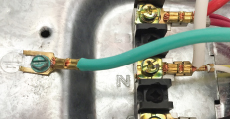
Grounding the neutral in dryers and ranges
A surprisingly common source of neutral on grounding paths was seen by the
author in some residential housing for low income groups including the elderly.
The multiple dryers in the laundry room were installed as delivered by the manufacturer
without following the procedure in the installation manual. These dryers are
routinely delivered with the neutral bus bonded to the case. The instructions
for use with four-pronged plugs, which are standard now, tell the installer
to remove the green and white bonding wire from the case and attach it to the
neutral bus. The instructions are confusing, but what this does is to return
the bonding conductor to the same bus it originated from, which is the same
as removing it. In any case, the installers sometimes either ignore this instruction
or else they think it is asking them to bond the case to the neutral, which
a fast reading might give them, so they do nothing.
The result is high-current neutrals bonded to cases which may be connected
to each other and to the washers by way of floor rails. In any case, I have
seen high currents on water pipes all the way through the building from the
laundry rooms to the service entrance rooms, causing elevated fields all along
the way. This may not be the electrician’s responsibility, but all he has to
do to check on the installation is to remove one plug and test for continuity
between neutral and ground on the plug. If continuity, then the bond must be
removed in each dryer. NEC no longer allows this bond. This also applies to
electric ranges.
Neutral on water pipes
A client may call you in because he/she has detected a strong magnetic field
from the water service pipe as well as the service drop. Usually this is noticeable
only when the water service comes in at one end of the building and the electrical
at the other. If the water service is metallic, the required grounding to the
pipe may allow some of the neutral current which should be going back on the
service drop to instead flow through the pipe where it completes the circuit
to the transformer by way of a neighbor’s house and their service neutral. This
will occur when one service drop neutral has a cleaner connection than the other.
Current may then see a lower impedance path to the transformer by way of the
water pipe to the neighbor’s neutral. The net currents set up run through both
houses and under the street where kids may play. An identical net current is
set up in the service drop, which now is missing some of its balancing neutral.
There have been cases where the service drop runs right outside a child’s bedroom,
causing high fields in the room. Magnetic fields penetrate most materials without
weakening.
The most straightforward solution to this situation is to advise the client
to have a plumber insert a dielectric union or a plastic section in the water
service pipe at least 10’ outside the building foundation. Since a water pipe
qualifies as a grounding electrode if at least 10’ is in contact with the soil,
this does not change the grounding situation as to Code. Sometimes electricians
are reluctant to advise any change in local grounding electrodes, and may get
quite excited about it, but I have found this is usually because they have the
misconception that local grounding electrodes are what allow fault currents
to trip breakers. Actually, as the fpn notes tell you in the Code, it is the
bonding to the service neutral that allows breakers to trip, not the connection
to local earth, which usually has too high an impedance to allow even a 15 amp
breaker to trip, let alone trip fast enough to prevent fire or shock.
On the other hand, allowing many amps of neutral current to flow on the public
water system is a danger to the water company workers and can result in lethal
conditions. The American Water Works Association has been making this point
for some time. Whenever I advise this plumbing change I tell the client to ask
the utility to come and check the condition of their service neutral connections,
both at the house and at the pole or pad-mounted transformer. If the neutral
connection is bad it will set up a higher voltage on one hot leg and a lower
voltage on the other. Either can damage motors and other loads.
Long service laterals inside commercial buildings
When the service entrance point is well inside a building with high loads,
such as a high rise office building, a possibility exists to set up such high
magnetic fields that office space has to be abandoned until the fields are brought
down. This results from the design of the installation, but it is the electrician
who has to deal with the problem. At the service entrance neutral and ground
are bonded. If this point is well inside a building, part of the neutral going
back to the transformer may go back on metallic paths such as building steel
and pipes and conduits of all kinds. This sets up net current in the service
lateral, due to missing neutral, as well as in the metallic pathways.
Example: In a high rise in Boston I found 20 amps of net current coming from
a steel beam which paralleled the service lateral. The beam, which ran under
the floor above, was producing about 60 mG at computer level in the office above,
which had been abandoned because of the computer monitor jitter. I found that
the 20 amps was traveling from the service panel on a circuit conduit until
it came to a hanger which was attached to the beam. It then followed the beam
out to the transformer where it got back to the transformer grounded neutral
point. The solution was simple: Where the hanger circled the conduit a piece
of rubber insulation was put in so the conduit did not touch the metal hanger.
With this alternate pathway cut off, no current flowed in the conduit or the
beam.
Paralleled runs: Another cause of net currents when the service is well
inside the building arises when paralleled service laterals are used instead
of one large cable. Unless the impedances of each set of phases (all A’s, for
instance) is equal, and that of the neutrals is also equal, net currents will
be set up, since the neutral running in each cable will not necessarily balance
the phases in that cable. Since the impedance can be most influenced by connector
tightness or corrosion, it is important to tighten them carefully. The cables,
of course, are required to be the same length, material, etc. See NEC 310-4.
It also helps to run the paralleled cables as close together as allowed.
Magnetic fields from appliances and transformers
Transformers generate high magnetic fields because the magnetic field increases
with every turn of the transformer coils. On the other hand, because they are
discrete sources their magnetic field weakens fast, with the cube of the distance.
In other words, as you double your distance from the transformer you cut the
field to one eighth. This compares with a net current from a line source, where
by doubling your distance the field is cut to just one half. This is a direct
relation with distance. Utility power lines without net current are in the middle,
weakening as the square of the distance. Double the distance and cut the field
to one fourth.
For this reason, residential transformers are usually not close enough to have
a measurable effect at the house, or even at the ground. Pad mounted transformers
do have locally high fields, which is why schools are fencing them in. They
make convenient and warm objects to sit on, but the field at the case is extremely
high.
A transformer in a commercial building may be close enough to office space
to produce a high field area. Usually service entrance cabinets also generate
fields, since large busses have enough separation to cause high fields locally.
Also the bus duct runs in high rise buildings may generate high fields locally,
weakening with the square of the distance like power lines. In these cases the
electrician needs to check whether net currents are involved, such as due to
water pipe grounding or if the service entrance point is well inside the building
and the neutral return paths to the transformer are divided between the neutral
conductor and perhaps conduits, water pipes and building steel, etc.
Shielding: Net current fields cannot be shielded. I work with
a shielding company which would be quite happy to solve these problems with
shielding, but they call me in to eliminate the net currents so they can go
to work on the massive balanced current sources.
Where no net currents are found, or found and corrected, the remaining field
from internal transformers or busses may have to be shielded. This is done by
a shielding company and involves heavy sheets of specialized ferrous metals
to absorb fields as well as a sandwich also using thick sheets of aluminum to
dissipate energy through eddy current losses. Lead is useless. Sometimes an
active counter-current loop is set up, but this is tricky and seldom used. A
counter current could be used to cancel a net current, but since the other half
of the loop generates a net current, this is seldom useful.
“Point sources”: In residences the discrete magnetic field sources are
the service entrance equipment including the meter, and appliances with motors
or transformers. Anything with a coil produces a high field which weakens fast.
Motors have coils; transformers have coils. The field from a computer monitor
or TV tube comes from the coil around the neck of the tube. Usually the strongest
source in a residence is the power transformer in the microwave oven. You need
to be 5 feet away to be outside the 2-3 mG level which is the usual level of
concern. For discussion of level of concern see the Sugarman book.
Small motors usually have higher fields than large. You might be asked to disconnect
the oven timer motor, since it gives a high field to someone standing over the
stove.
Troubleshooting
This book is about theory and so it is not appropriate to go into troubleshooting
net current circuits except in a general way. For a complete exposition of the
process see my book, Tracing EMFs in Building Wiring and Grounding.
Troubleshooting involves having the right instruments. A gaussmeter is necessary
to measure fields and identify sources. You can get a professionally accurate
one for $200 (see notes on instrumentation). To follow and locate the net-current-producing
error you need two or three sizes of clamp-on ammeters, though a single medium
sized one will take you a long way if it is digital. Analog meters are less
sensitive.
Starting at the panel from which the net current circuit originates, a visual
inspection may reveal incorrect neutral bus bonding or other obvious problems
such as a single conductor in a conduit. Next you use your clamp-on ammeter.
The process involves clamping around every group of conductors leaving the panel
until you find one group that does not read zero. This is a different use of
the ammeter than you may be used to. Any circuit or group of circuits should
read zero if correctly wired. When you find one with a net current it is usually
in the 1 to 6 amp range, though I have seen up to 40.
Once you have found a circuit with a net current, you measure each conductor
separately and this will tell you what is going on in the circuit. Is there
missing neutral, or an excess of neutral? Is there current on the equipment
ground or the conduit? Once you have this information you move out into the
circuit. This usually involves clamping around conduits if the building uses
them and opening junction boxes and clamping around conductors to find the point
where the error was made.
This is the barest outline of the trouble-shooting process. It is complex but
some electricians may find it extremely interesting and may want to make it
a specialty, as there may be a large demand for these skills in the years ahead.
It is detective work, and if you like detective work, your day may be a lot
more interesting than when you are doing your usual routine.
Notes:
Instrumentation
Gaussmeters: for walk-through surveys I recommend the Bell 4080 triaxial
gaussmeter. Triaxial means that since it has three coils it will read correctly
in any position. For tracing linear sources I recommend a single-axis meter,
the MSI AJK-95 which has a flexible probe and gives you directional information
as well as being extremely accurate. An instructional booklet comes with it.
Both these meters are available from MSI at (800) 749-9873. They also have a
web site under magneticsciences.com.
Clamp-on ammeters of different sizes are needed:
Mini ones for getting around circuits in crowded panels. Find a catalog which
carries Yokogawa minis such as the CL-611 with its ¾ inch opening. Or call Yokogawa
for a dealer – (800) 258-2552.
Larger-jawed for clamping around conduits and smaller pipes. I recommend theTenma
72-555 with its 2 ¼” opening, which plugs into any digital multimeter with a
200mV AC voltage setting (the meter which comes with the MSI AJK-95 gaussmeter
can be used) from MCM Electronics at (800) 543-4330).
2’ to 3’ flexible probes for encircling large cables, busses, and large water
pipes. This also plugs into a digital multimeter with 200mV AC setting. Contact
AEMC about their AmpFlex, specifying the 30/300 amp range with a 3’ flex, (800)
343-1391 for a dealer.
Books: Tracing EMFs in Building Wiring and Grounding, by Karl Riley,
133p, many illustrations, MSI, 1995, $28.00, available from Mike Holt and MSI (see above number).
Warning, the Electricity Around You May Be Hazardous to Your Health by
E. Sugarman, 1998, Miriam Press, (800) 884-6763. First edition was published
by Simon & Schuster.
|